Habits

Andrew Kim
9 min read
How to build a reading habit without counting pages
Page counting makes people read more, enjoy it less and stop sooner, so a reading habit is better built on a fixed time, a fixed place and a one-page floor.
Sixty-six students sat down with a book excerpt and eight minutes to read it. Half of them could see a small box in the corner of each page counting the pages they had finished, and that half read more, 16.70 pages against 14.36. Then everyone was offered a few more minutes with the book. Among the students who had watched the counter, 27.3 percent wanted to carry on. Among the ones who never saw it, 48.5 percent did.
Fix the time and the place, set a floor low enough to clear on a bad night, and count days rather than pages. That is the short answer to how to build a reading habit, and the last clause is there because the page count is the one piece of the standard advice anybody has run an experiment on, and it came back the wrong way.
The pages ranking for this question all end on tracking. The Focused Method wants a minimum viable action inside a habit loop, EasyHabits wants six minutes and a streak counter, Chapterly wants 25 pages a day and a progress log. None of the three cites a study of people reading. The two numbers they do reach for, a 68 percent drop in stress and roughly two extra years of life, turn out to belong to a chocolate brand's book giveaway and to an observational study that was never able to show reading caused anything.
The page counter is the part that has been tested on readers
Jordan Etkin at Duke's Fuqua School of Business ran six experiments for a 2016 paper in the Journal of Consumer Research, and three of them were about reading. The setup was deliberately plain. People read a book excerpt split into pages on a screen, clicking to advance, and the only thing that changed between conditions was whether the top left corner told them how many pages they had read.
In the largest of the three, 310 students read for eight minutes. The counter group got through 16.14 pages against 13.44, so measurement did exactly what a habit app promises it will. Enjoyment went the other way, 5.19 against 5.97 on a seven-point scale. The gap survived when the experiment first described reading as fun and disappeared when it described reading as useful and educational, which is the result that explains the rest: the counter made reading feel like work, and it only cost something where reading had felt like play.
Etkin's second reading experiment took the counter away again. Two hundred and thirty-six adults recruited online read for eight minutes with it or without it, then carried on for two more minutes with no feedback at all, and the ones who had been watching a number read less once it vanished, 3.75 pages against 4.20. Choosing to look was no protection. When the counter was made optional, 93.9 percent of that group checked it anyway, on average 2.68 times in eight minutes, and they showed the same drop in enjoyment and the same collapse in wanting to keep going.
Keep the limits in view. These were eight and ten minute sessions with students and online workers rather than months with a novel, and the number sat in front of people while they read instead of waiting for them the next morning. Nobody has tested a tick you make after you close the book. What the evidence supports is narrower than a ban on tracking: keep the count out of the reading itself. It sits alongside the older finding that paying people for something they already enjoy can flatten the wanting, which is the trap we went through in how to reward yourself so the habit outlives the reward.
How to build a reading habit, sorted by what has been measured
Here is the standard advice with the evidence attached, and the empty rows marked empty.
| Move | What was tested | What it changes | What it does not |
|---|---|---|---|
| Fix a time and a place | Gollwitzer and Sheeran 2006, 94 tests of if-then plans | Goal attainment at d = .65, medium to large | None of those 94 tests was a reading habit |
| Keep a floor of one page | Nothing | Nothing anyone has measured | It is the single most repeated line on this search result |
| Watch your page count | Etkin 2016, 310, 236 and 66 readers | Raises pages read while the counter is visible | Cuts enjoyment, and fewer people keep reading once it is removed |
| Mark the day done afterwards | Nothing on reading | Unknown | It is not the same object as a live counter, and no trial has separated them |
| Move the phone out of reach | Heitmayer 2025, 22 workers over two five-hour days | Non-work phone pickups fell from 17.5 a session to 6.5 | The leisure time moved to the computer, so the hours did not come back |
| Read on paper rather than a screen | Delgado 2018, 54 studies, 171,055 participants | Comprehension favours paper at g = -0.21, more so under time pressure | For narrative text the advantage was g = 0.01, which covers most reading for pleasure |
| Count the audiobook | Rogowsky 2016, 91 adults | No comprehension difference against an e-reader, immediately or two weeks later | One chapter of one book, with nobody allowed back over a passage |
| Wait for it to feel automatic | Lally 2010, 96 volunteers over 84 days | A median of 66 days to reach automaticity | The range ran 18 to 254 days, and none of the behaviours studied was reading |
The top row is the measured version of habit stacking, the move every one of those guides recommends in the words "after I pour my coffee, I will read". Peter Gollwitzer and Paschal Sheeran pooled 94 independent tests of naming the when, the where and the how, and put the average effect on goal attainment at d = .65. It is the strongest thing in the table and the cheapest to do. The page-count row is the only one measured on people in the act of reading, and it argues against the step those same guides finish on.
A page takes about a minute, so 25 pages is half an hour
Marc Brysbaert went through 190 studies covering 18,573 participants and put average silent reading at 238 words a minute for non-fiction and 260 for fiction, with most adults falling between 175 and 300. A printed page holds somewhere near 250 to 300 words, the convention the Chicago Manual of Style's editors use when they estimate a book's length from a manuscript. Do the division. A page of a novel is roughly a minute.
That makes the popular targets legible. Chapterly's 25 pages a day, which it prices at 20 to 30 minutes and about 30 books a year, is close to half an hour of reading every day forever. The American Time Use Survey reports that Americans aged 15 and over read for an average of 16 minutes a day in 2025, against 2.6 hours of television. Fifteen to nineteen year olds read for nine. So the beginner's target on that page asks someone who currently reads nothing for nearly double the national average, starting tomorrow.
One page is a minute, and a minute is a floor you can clear at 11:40 p.m. on the night the train was late. Gallup asked Americans in December 2021 how many books they had read in the past year and got an average of 12.6, down from 15.6 in 2016, the lowest it had recorded since 1990, with a median of five. Nobody reaches five books a year by reading 25 pages a night. They reach it by reading on more nights than they don't.
Which gives you three lines to set up tonight:
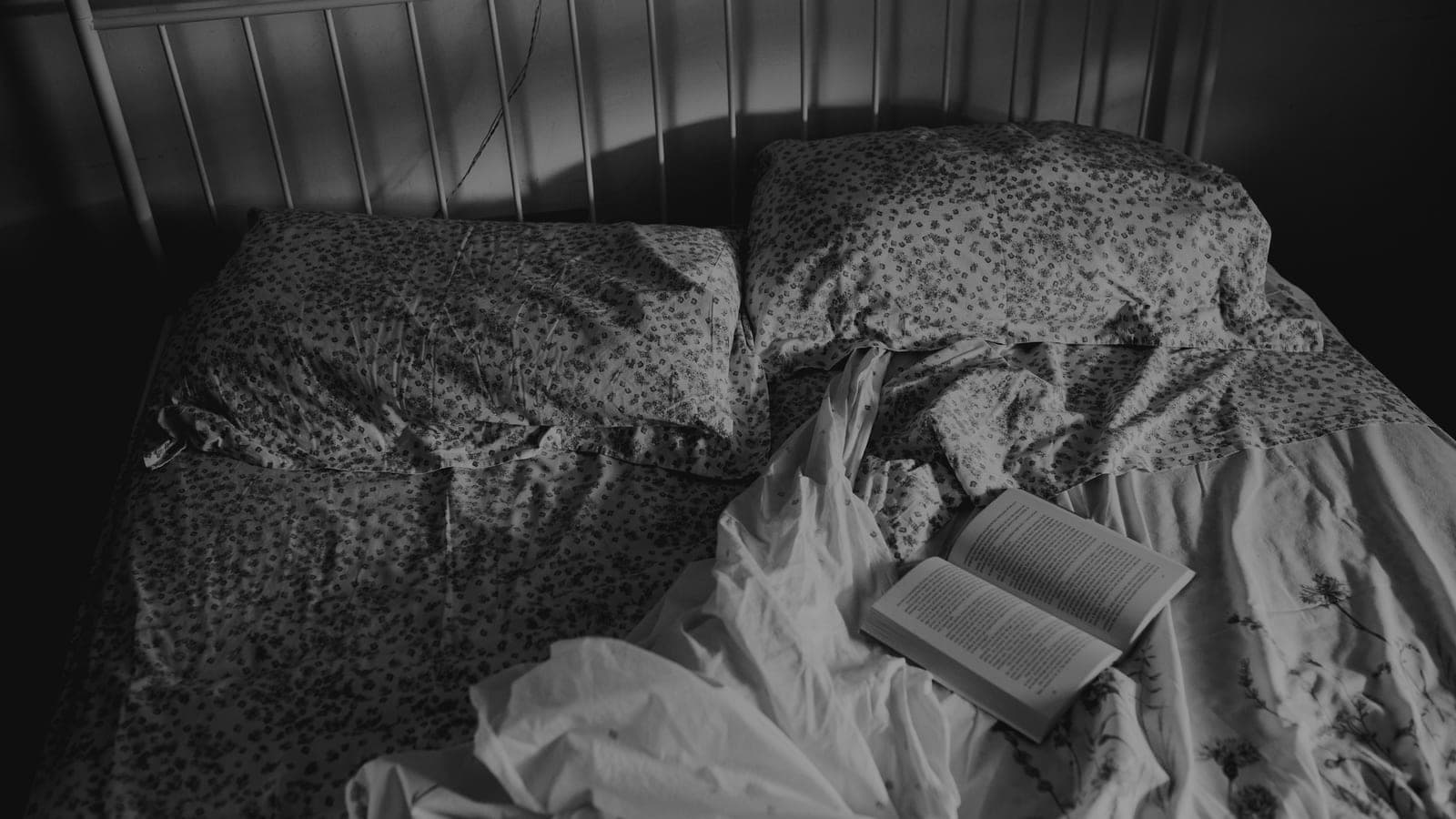
- Name the cue in a sentence: after I get into bed, I read one page of the book on the pillow.
- Put the book where the cue happens, and the phone where it doesn't.
- Record the day, once, when you're done. Leave the page number out of it.
Two numbers these guides keep repeating
The 68 percent figure turns up all over this topic, usually as "a 2009 University of Sussex study found that six minutes of reading reduces stress by 68 percent". The Telegraph ran it on 30 March 2009, reporting that a consultancy called Mindlab International, based at the university, had raised volunteers' heart rates and then tried various ways of bringing them back down, with reading beating music at 61 percent, tea or coffee at 54 percent and a walk at 42 percent. The last line of the same wire copy is the part that never travels with the number: "The research was commissioned by Galaxy chocolate to launch a campaign to give away one million books over the next six months." No paper followed, no sample size was reported, and the method exists only in press coverage. EasyHabits goes a step further and says the finding "has been replicated in multiple settings", naming none of them.
The longevity claim has a real study behind it wearing the wrong name. EasyHabits calls it "a 12-year University of Michigan study" showing that half an hour of daily reading buys roughly two extra years. The paper is Avni Bavishi, Martin Slade and Becca Levy at Yale, published in Social Science and Medicine in 2016, and it follows 3,635 people aged over 50 in the Health and Retirement Study, the long-running survey Michigan runs. Book readers held a 23-month survival advantage at the point where 80 percent of the cohort was still alive, and a 20 percent lower mortality risk after adjustment for education, wealth, health and depression. Thirty-three percent of the non-readers died during the follow-up against 27 percent of the readers. Nobody was assigned to read. The honest sentence is that book readers outlived non-readers, not that the reading bought the months.
Paper, screen or audiobook
The audiobook question has the cleanest answer of the three. Beth Rogowsky, Barbara Calhoun and Paula Tallal gave 91 adults the preface and one chapter of Unbroken as an audiobook, as e-text, or as both at once, then tested comprehension immediately and again two weeks later. No condition beat any other at either point. Their own caveat is worth carrying: nobody was allowed to go back over the material, and an earlier study that did allow it found an advantage for the written version.
Paper against screen splits by what you are reading. Pablo Delgado and three colleagues pooled 54 studies and 171,055 participants and found a small advantage for paper, g = -0.21, which grew when people read against the clock. Sort by text type and that advantage belongs to informational writing, while narrative text came out at g = 0.01. Read a novel in bed at your own pace and the medium barely matters. The device matters for a different reason, since it is also where the notifications live, and putting it out of reach helps less than the advice suggests because the leisure time tends to migrate to whatever screen is left in the room.
The night you don't read
Half of British adults don't read regularly. The Reading Agency surveyed more than 2,000 of them in 2024 and found 50 percent reading regularly against 58 percent in 2015, with 35 percent calling themselves lapsed readers who used to read and have stopped. Among 16 to 24 year olds, 44 percent had lapsed. People named the barriers as time at 33 percent, focus at 28 percent and social media at 20 percent, and 30 percent said they struggle to finish what they start.
That last figure is the best case for abandoning a book you aren't enjoying, which is an instruction every one of these guides gives and none has tested. It costs nothing to follow. A book you are 60 pages into and dreading is a nightly appointment with a chore, and the appointment is the thing you're protecting rather than the particular book.
When a day does get skipped, skip it properly. In Phillippa Lally's 12-week study of 96 people building a daily habit, missing a single opportunity did not measurably set the habit back and the automaticity curve carried on as if nothing had happened. What does the damage is the story you tell about the gap, which is why we argued for building a streak you can restart. Read one page tomorrow. The counter was never the habit.
Sources
- The Hidden Cost of Personal Quantification. Journal of Consumer Research 42(6), Jordan Etkin, April 19, 2016.
- Implementation Intentions and Goal Achievement: A Meta-Analysis of Effects and Processes. Advances in Experimental Social Psychology 38, Peter M. Gollwitzer and Paschal Sheeran, 2006.
- How many words do we read per minute? A review and meta-analysis of reading rate. Journal of Memory and Language 109, Marc Brysbaert, December 2019.
- Counting Pages or Words in a Manuscript Submission. CMOS Shop Talk, The Chicago Manual of Style, September 21, 2021.
- Americans age 15 and over read for an average of 16 minutes per day in 2025. The Economics Daily, U.S. Bureau of Labor Statistics, July 22, 2026.
- Americans Reading Fewer Books Than in Past. Gallup, January 10, 2022.
- Reading 'can help reduce stress'. The Telegraph, March 30, 2009.
- Reading can help reduce stress, according to University of Sussex research. The Argus, Andy Chiles. Read 28 September 2026.
- A chapter a day: Association of book reading with longevity. Social Science & Medicine 164, Avni Bavishi, Martin D. Slade and Becca R. Levy, September 2016.
- Book up for a longer life: readers die later, study finds. The Guardian, Alison Flood, August 8, 2016.
- Don't throw away your printed books: A meta-analysis on the effects of reading media on reading comprehension. Educational Research Review 25, Pablo Delgado, Cristina Vargas, Rakefet Ackerman and Ladislao Salmerón, November 2018.
- Does Modality Matter? The Effects of Reading, Listening, and Dual Modality on Comprehension. SAGE Open 6(3), Beth A. Rogowsky, Barbara M. Calhoun and Paula Tallal, September 2016.
- How are habits formed: Modelling habit formation in the real world. European Journal of Social Psychology 40(6), Phillippa Lally, Cornelia H. M. van Jaarsveld, Henry W. W. Potts and Jane Wardle, 2010.
- The British Reader is in Decline as The Reading Agency Reveals Half of UK Adults Don't Read Regularly. The Reading Agency, July 24, 2024.
- How to Build a Reading Habit That Sticks (Even If You've Tried Before). EasyHabits, 16 April 2026. Read 28 September 2026.
- How to Read More Books: 12 Proven Strategies for Busy People. Chapterly. Read 28 September 2026.