What an accountability group is for
People run these groups for faith, recovery, writing, study, fitness and business. The shape stays the same everywhere: somebody makes a commitment, somebody else hears it, and later the first person has to say how it went.
That last step is where the value sits. In Gail Matthews's study at Dominican University, people who sent weekly progress reports to a friend got further with their goals than people who told the friend once and left it there. It was a small study with a lot of dropouts, so take the direction rather than the number, but larger work on monitoring progress points the same way.
Keep it small enough that an absence shows
A room of forty people can lose one without anybody noticing, which is the opposite of what you came for. Start with four or five people you would feel bad letting down.
Friends are the strongest version of this. When Rena Wing and Robert Jeffery ran a weight loss programme in 1999, 66 percent of the people who came as a team of four friends and got social support had kept their loss in full ten months on, against 24 percent of those who came alone on the standard programme. It's one study about one goal, but friends also know what a normal week looks like for you, so a vague update won't get past them.
Agree what counts before you start
A vague commitment produces a vague update. "Work on the thesis" can't be missed, which means it can't be kept either. Ask each person to name the thing and the day: two chapters by Friday, three gym sessions this week, the invoice sent before lunch on Monday.
Agree how often you report as well. Weekly suits most groups, because a week is long enough for real progress and short enough that nobody can drift for a month. Whatever you choose, make it the same for everybody.
Report to a person, not to a room
A message addressed to everybody gets read by nobody in particular, and that is the weak spot of every group chat. So give each member one named person in the group who expects to hear from them, and swap the pairs every month or so. The group supplies the company, and the pair supplies somebody who will notice. What an accountability partner is actually for goes further into why it has to be one person.
Plan for it to fade
It will. Wing and Jeffery found that the support people felt from their group fell across the ten months in every condition, including the one built to raise it. That's normal, and it doesn't mean your group has failed.
So decide now what happens when it dips. Put an end date on the first round, six or eight weeks out, and ask everybody whether they want another. A group that ends on purpose is easy to restart. One that drifted away is awkward to bring up.
Decide what a missed week means
Somebody will miss. If that earns them a telling-off, they'll stop reporting, and then you've lost the one thing the group does. The useful rule is that a missed week gets reported like any other: what happened, and what the plan is for this week. Nobody has to defend anything.
Running one in Kudos
Kudos does the reporting for you, because finishing a task is the report. It won't choose your people or settle what counts, but it does keep everybody's week in one place.
- Make a group, name it, and share the invite link. It holds up to 50 people, though you'll probably want far fewer.
- Everybody adds this week's commitments as ordinary tasks, and what they finish appears on the group's Activity tab.
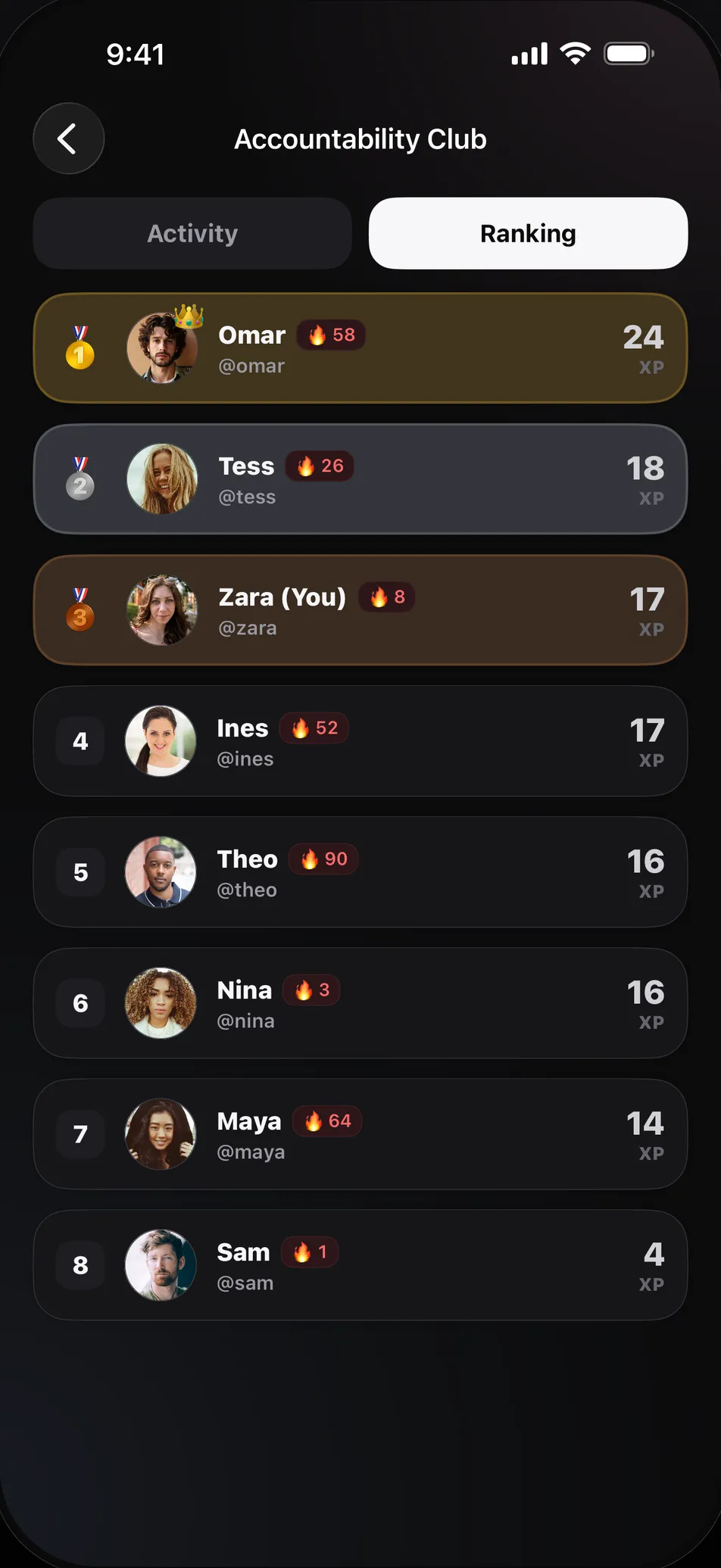
- The group's ranking runs on XP earned this week, Monday to Sunday, so everybody starts at zero and it's easy to see who has gone quiet.
- The chat is there for the conversation, and a kudos is one tap of applause for a good week.
- Mark anything personal as Private. People see "Private Task" instead of the title, and it still counts toward your rank.
Common questions
- How many people should be in an accountability group?
- We'd start with four to six: enough that one person's bad week doesn't stop the group, and few enough that a missing person is obvious. Wing and Jeffery's teams were four friends.
- How often should an accountability group meet?
- Weekly suits most groups. It doesn't have to be a call. What matters is that everybody reports on the same schedule.
- What do you do in an accountability group?
- Say what you'll do by the next check-in, report on what you said last time, and ask for help where you're stuck. Keep it short, because a group that takes an hour a week is one more thing to fall behind on.
- Can an accountability group work online?
- Yes. All it needs is a regular report that other people can see, whether that is a video call, a group chat or an app.
- What's the difference between an accountability group and an accountability partner?
- A partner is one person who expects to hear from you. A group is several, which gives you more company and more room to hide. Pairing people up inside the group gets you both.
- Is there an app for accountability groups?
- Kudos is one. A group has a chat, a feed of what its members finish, and a weekly ranking, and the app is free on iPhone and Android. Here's how it works.